Meeting Readout
Haiti Working Group Meeting on the Economy and Job Creation
June 18, 2026
Key Judgements
- Economic recovery belongs in the first tier of Haiti policy, alongside security and governance, rather than a task to be deferred until those are settled. Jobs and growth should be part of the security strategy. Any opening the GSF creates will close again if income, commerce, and investment do not move in quickly behind it.
- Under the best of circumstances, Haiti will need generous financial and technical support from the US and many other nations for at least the next five to ten years.
- Haiti's economic collapse is structural, predating the latest upsurge in gang violence. Today's collapse traces back to “excessive trade liberalization” in the 1980s, which undermined an already weak manufacturing sector; regressive taxation combined with low revenue collection; widespread informality; and an elite that profits from controlling trade rather than producing. Output has fallen for eight straight years, and the economy is now about 16 percent smaller than it was in 2018. The fiscal situation is precarious. Firms have also lost 40% of their assets and investment is down 25% since 2021.
- These trends predate the current gang takeover of the capital. Restoring security will not, by itself, fix the structural issues behind Haiti's long-term economic decline.
- Notably, some elites profit from the current environment. As economist Reginald Surin put it: “Haiti's low equilibrium is exceptionally profitable for those who know how to inhabit it. Control over points of passage—ports, customs, licenses, corridors, administrative access—generates returns without productive investment and without exposure to market risk. Diaspora transfers, which exceed four billion dollars annually, sustain domestic demand that captive imports and monopolistic distribution siphon off regardless of local production. This external windfall disconnects the prosperity of the extractive faction from the health of the productive market. It matters little if the real economy contracts; the flows feeding the rents continue.”
- While the crisis is decades in the making, the productive base has survived. Despite suffering years of crisis Haitians have kept farming, trading, and schooling their children, maintaining a foundation of human capital on which to rebuild. Although the crisis has most affected three departments—West, Artibonite, and Central, three of the most populous of the country's departments—much of Haiti is less affected.
- Security is necessary but not sufficient, and Haiti has yet to plan for the day after. How to hold recovered ground, restore income and basic services, reopen commerce, and rebuild what firms have lost has yet to be planned for and articulated clearly by the government and international partners.
- Jobs are both the goal and the route forward, the central tool of both security and social protection. This is especially true for young people, the displaced, and women. Youth unemployment approaches 40 percent in a country where more than half the population is under 25, and displaced young people are the group most exposed to gang recruitment. Short-term cash-for-work programs can be a bridge to build the capital base, raise production, and protect competitiveness.
- Trade preferences and remittances are lifelines, and both are politically fragile. Apparel is more than 90 percent of exports and most formal manufacturing jobs, and it has already fallen from about 60,000 jobs in 2021 to 20,000–35,000 today. The year-by-year renewal of HOPE/HELP, which lapses at the end of 2026, has undercut employment by eliminating the ability of companies to make meaningful investments. In addition, remittances are close to $4 billion a year, about a fifth of GDP. They hold the economy up, and an abrupt end to Temporary Protected Status would close off a crucial source of income for Haiti, further deepening the country's humanitarian crisis.
- Sustained recovery requires moving from aid to investment in larger scale projects with long payback periods. Haiti's high-risk profile, as a poor, heavily indebted country, has scared off long-term capital, making the country rely on donations and grants. Moving from grants toward preferential multilateral financing for larger projects, such as infrastructure, is needed to escape the poverty trap.
- Agriculture and food security are high impact quick wins, with potentially long-lasting results. Haiti imports over 80 percent of what it eats, even as acute hunger has reached about 5.7 million people. Farming is the largest rural employer and the fastest way to increase available food. It creates jobs and provides the nutrition needed to support workers and students. It is beset by lack of seeds, state support, fertilizer (a fraction of the regional norm is available), irrigation, and adequate infrastructure, especially roads to get products to markets.
- Only growth, not better tax collection, can pay for a functioning Haitian state. Haiti collects about 6 percent of GDP in tax revenue, about $129 per citizen compared to $1,718 in the Dominican Republic. Recovering every exempted and stolen dollar would close only an estimated 4 to 5 percent of that gap, and even collecting at the same rate as the Dominican Republic would be insufficient. The constraint is the size of the economy itself.
- Customs reform is a powerful step that would both increase state revenues and deprive gangs and elites of illicit income. Customs brings in a third to half of government revenue, but much is lost to corruption at the port of entry. Setting the value of goods before they ship, clearing them digitally, and routing duties into a secure account would disempower corrupt actors and protect honest businesses from unfair competition.
- A customs modernization contract reportedly negotiated with a private consortium raises concerns about transparency and control of public revenues. Modernizing customs is necessary but handing a core state function to a private operator for ten years under an opaque contract, during an unelected transition, is a major decision that has had almost no public scrutiny.
Recommendations
- Programs should build on Haiti's assets: a young workforce, competitive wages, proximity to major markets, and high-value agricultural potential (cacao, vetiver, mango, coffee, rice import-substitution), among others.
- The United States should renew HOPE/HELP for several years at once rather than in short extensions, paired with enforceable labor protections that include preventing gender-based violence in factories. A short renewal will not unlock hiring or capital.
- Key reforms need immediate attention, even prior to elections: fiscal reform (rebuilding domestic revenue, transparent budgeting, phasing fuel subsidies into targeted transfers); rule of law (a functioning justice system, property and contract enforcement, anti-corruption, central-bank independence); and capacity in the areas that matter most (customs and ports, public investment management, the central bank, and basic service delivery).
- Special attention should go to restoring the capacity of the state to provide essential services (justice, security, defense) and other public goods (health, education, infrastructure).
- Customs could be the flagship economic reform and is ripe for change: set the value of goods before they are shipped, handle clearance digitally, and pay duties into a protected account. The United States should also help enforce rules requiring that imported goods enter through Port-au-Prince, since many goods bound for Haiti are shipped first to the Dominican Republic and then cross by land, avoiding duties; better security and customs enforcement along the border would also curb illegal gun and drug smuggling.
- Donors and Haitian authorities should stand up job programs and public services within weeks of any security gain in “liberated” areas, through cash-for-work and labor-intensive public works at scale — a public reconstruction pipeline of large-scale projects (clearing rubble, drainage, roads, housing, schools, clinics, markets) that reaches the displaced and includes women and youth, alongside the return of water, power, banks, and markets.
- International and Haitian planners should treat agriculture and food security as an immediate priority, focusing on seeds, fertilizer, irrigation, roads to markets, and more local purchasing.
- International partners should focus on the sectors with the highest potential — those whose value chains (production, transformation, distribution) create short- to medium-term spillovers, and businesses that previously functioned. Firms that were forced out need war-risk insurance and guarantees to recapitalize, on the condition that they reopen and rehire rather than cash out.
- Donors should connect new power to customers who pay, letting producers build mini-grids to reliable payers and funding a gas-import terminal at the port, so that added generation lowers costs instead of deepening the state's losses.
- Donors and Haitian authorities should bring the parties to any private customs concession to the table for a frank, on-the-record account of its terms and what it would cost the treasury, and should attach transparency conditions to major new investments.
- International actors should strive to replace aid with investment, through preferential multilateral financing and deeper cooperation within the hemisphere — including Mexico, Brazil, Chile, and Colombia, regional labor mobility through CARICOM, and a carefully managed relationship with the Dominican Republic — and should seek creative public-private partnerships that leverage capital and new partners.
- Built into all assistance there is a need for several intangibles — respect, dignity, and hope. Greater respect for Haitian history and culture would lead to better outcomes; programs should be delivered with dignity and generate hope rather than reinforce a narrative of persistent failure.
Introduction
On June 18, 2026, members of the Haiti Working Group convened virtually for the third session of the year, following a February meeting on politics and security and a March meeting on humanitarian conditions. The subject was the economy and job creation, taken up as the Gang Suppression Force (GSF) begins to arrive.
Moderator Keith Mines framed the meeting by referring to remarks by Haitian Prime Minister Alix Didier Fils-Aimé in a recent CNN interview: that security and economic recovery are not sequential but a single package, part of a move “from aid to trade,” because “when the guns fall silent, the jobs must follow.” Throughout the session, participants stressed that economic recovery is not a second- or third-order concern, but a first-tier priority that must advance alongside efforts to restore security and governance. The meeting included four presentations by speakers with long experience in Haiti: a veteran regional economist; two economists who have worked at multilateral development banks; and Jeff Frazier, one of the organizers reporting a survey of Haitian businesses.
The meeting was moderated by Keith Mines, former head of USIP’s Latin America Program, and organized with the help of working group co-chairs: Mary Speck (former USIP), Peter Hakim (IAD Emeritus), and Jeff Frazier (Stimpack-Strategies for Haiti), and supported by the University of Notre Dame’s Keough School of Global Affairs. It followed Chatham House principles: assessments are presented without individual attribution to encourage candor and allow for the sharing of broad conclusions.
Background
I. From Aid to Trade
The session was built on the premise that security and economic recovery must improve together, not sequentially. With the GSF arriving, the conveners set the temptation to treat stabilization as the thing that must come first against the Prime Minister’s “aid to trade” framing: opportunity and jobs are themselves part of the security strategy, because many young people joined the gangs for lack of better opportunities.
The four presentations analyzed the economy from different angles — a structural diagnosis, the pathway from stabilization to durable growth, the external lifelines of trade and finance, and a survey of Haitian business. They converged on one point: the economic groundwork must be laid early.
II. Structural Diagnosis
The first presentation placed the crisis in historical perspective: Haiti’s economic malaise is structural and long-running, not a side effect of the current insecurity. The economy has shrunk by roughly 2.4 percent each year since 2019. Inflation has run at 25 to 30 percent, revenue at 5 to 7 percent of GDP, and 80 percent of the labor force works in the informal sector.
“The cake is too small.” Haiti has about the same population as the Dominican Republic, but it produces only about a tenth of what its neighbor produces.
Remittances, which totaled about $4 billion in 2025, provide some exchange-rate stability but at the cost of migration. This phenomenon is not unique to Haiti but common throughout Central America and the Caribbean.
Weak job creation is not a recent phenomenon but a story that goes back decades. The country opened its economy to imports too quickly in the 1980s, flooding markets with U.S. rice and other agricultural goods. This “excessive trade liberalization” turned Haiti from a country that once grew much of its own food into one that imports more than it produces.
Haiti’s “rentier” elite lives off controlling trade, not agriculture or industry. Regressive taxes — including VAT and other indirect taxes — fall hardest on those least able to pay.
“Generating hope” is crucial. “A narrative of failure often surrounds Haiti and its prospects, fueled by both internal and external actors.” How have millions of Haitians survived five to eight years of crisis? “In most of the country, families continue to send their children to school every day, even if it’s a gamble. Thousands of farm laborers and agricultural workers continue to sow and harvest on their small plots of land. They are not waiting for a handout.”
III. Planning for the Day After
The second presentation laid out, step by step, what has to follow if the GSF succeeds in clearing parts of Port-au-Prince.
First, consolidate security gains — hold the ground with a steady police and justice presence and by giving ex-gang members, especially youth, a path to disarm and to work. Second, get income and basic services flowing within weeks, through cash-for-work and the return of water, power, waste collection, schools, clinics, banks, and markets. Third, reopen commerce, by restarting the Port-au-Prince port, customs, and trucking and by securing corridors for trade and fuel supply. Fourth, rebuild the capital base and restore productivity. Firms have lost about 40 percent of their assets, per official statistics, and investment is down by about a quarter.
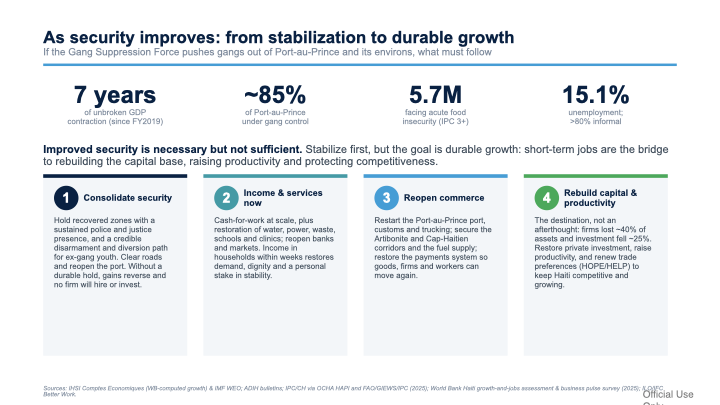
One of the challenges is ensuring the “intellectual leadership” needed for medium- to long-term planning. “Security is necessary but not sufficient. We need to start thinking about the day after.”
IV. Trade and Investment
The third presentation focused on the need for external support to revive both internal and external trade. Haiti’s cumulative lost output comes to about $9.7 billion, on the order of 39 percent of what the economy could have produced.
Restoring freedom of movement must be a priority: the Port-au-Prince port handles 80 to 90 percent of the capital’s containers, the RN1 and RN2 corridors connect nine of the ten departments, and the Artibonite Valley grows almost 90 percent of the country’s rice.
It is also important to support the women who “make up the majority of Haiti’s informal retail workforce.” Reviving the “Madam Sarah” networks that move food from rural areas to urban markets should include not only “cash for work,” but also gender-responsive provisions, such as childcare and safe-work sites.
Agricultural recovery is the fastest way to provide jobs and food security. About 5.7 million people, roughly half the country, suffer from acute hunger. Agriculture is severely under-resourced: Haiti uses about 3.8 kilograms of fertilizer per hectare compared to more than 100 kilos elsewhere in Latin America.
More than 80 percent of the food consumed in Haiti is imported. Buying more local food for schools would both raise rural incomes and improve food security. The World Food Program already sources 70 percent of the food it uses from Haitian farmers.
Apparel and textile assembly accounts for more than 90 percent of exports and most formal manufacturing jobs. It has fallen from about 60,000 jobs in 2021 to about 20,000 to 35,000 today.
“The single most impactful action that the United States could take right now for Haiti’s economy is a long-term, multi-year renewal of the HOPE/HELP trade preference.” A short extension is not enough. “Investors don’t make hiring and capital decisions on one-year horizons.” Renewal should also be paired with enforceable labor protections, including the prevention of gender-based violence in factories where women make up most of the workforce.
Preferential financing from the multilateral banks was urged as the way past the trap in which heavy debt confines Haiti to grants while its risk profile scares off longer-term projects. There is also a place for deeper cooperation within the hemisphere. To date Mexico has trained more than 900 Haitian military personnel since 2018, and it and others could help more with security and justice, essential pillars for the economy. Brazil, Chile, and Colombia can offer technical and agricultural help, CARICOM could open the door to regional labor mobility, and the Dominican Republic remains Haiti’s single most important partner on trade, the border, and migration.
V. Fiscal Solvency and Private Sector Asks
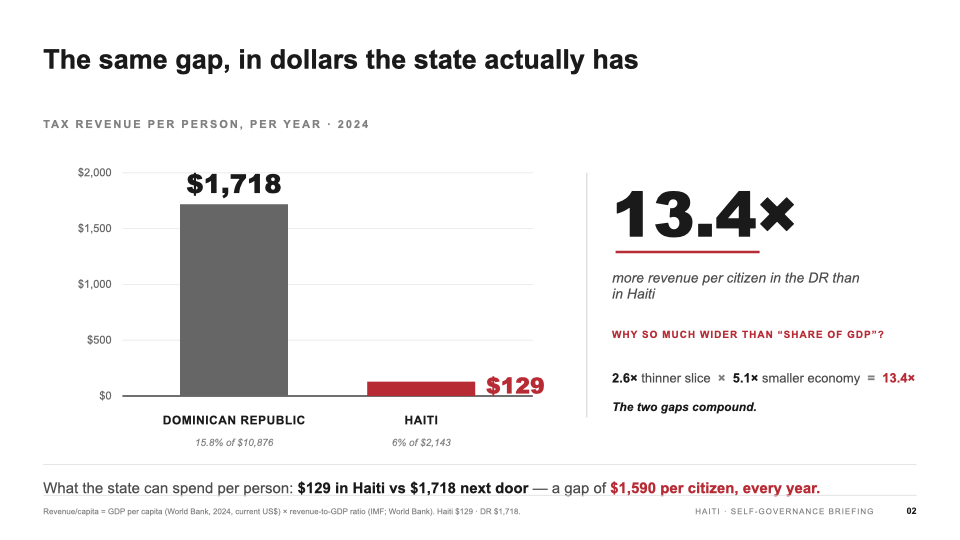
The final presentation, drawing on a survey of Haitian business leaders, investors, and trade partners, put numbers on the country’s ability to pay its own way. Haiti collects about 6 percent of GDP in taxes, against roughly 15.8 percent in the Dominican Republic and 25 percent in the United States, about $129 per person a year next to $1,718 across the border, a gap of more than thirteen to one.
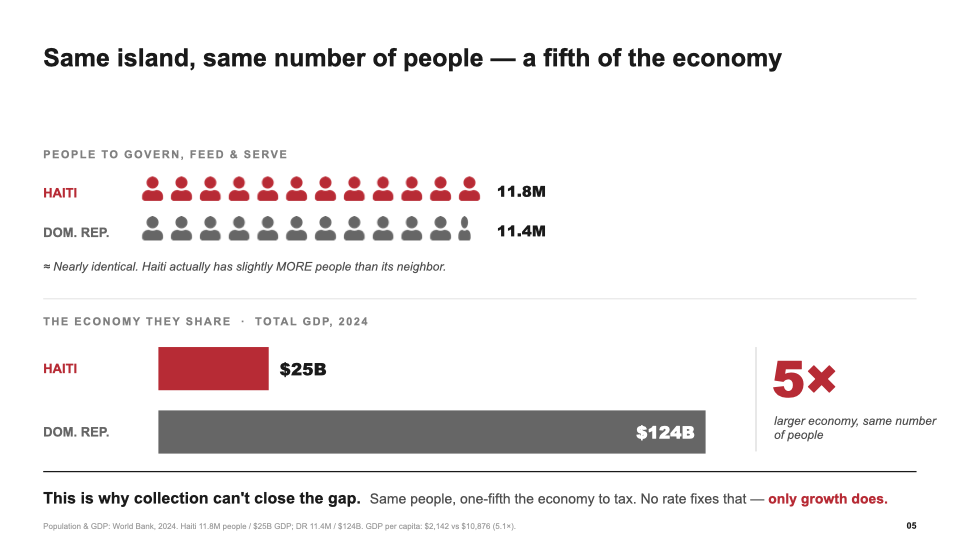
Neither cleaning up corruption nor improving collection can close this revenue gap. Haiti and the DR have nearly the same number of people, but Haiti’s economy is only one-fifth the size of the Dominican Republic’s. “All solutions go through economic development.” A state cannot tax its way to solvency on an economy this small; it has to grow the base.
Asked what they would need once there is a floor of security and a functioning government, the business leaders surveyed named four concrete, under-discussed ideas.
First, fix customs: value goods before they ship, clear them digitally, and pay duties into a protected account — the highest-return reform on the table, since the port is about a third of government revenue and gangs skim an estimated $65 million a year around it.
Second, close the back door by forcing importers to bring goods in through Port-au-Prince. Many importers try to evade delays in Port-au-Prince (and paying customs duties) by shipping goods into the Dominican Republic and then by land into Haiti. Much of this cross-border trade is under-valued or mislabeled, undercutting honest importers by about 30 percent. Smugglers of illegal arms and drugs also use these routes. The Haitian government ordered imports to arrive by sea in 2025 but has been unable to enforce this regulation. The United States should back this rule, working with the Dominican Republic on enforcement.
Third, build power around customers who pay, letting producers run mini-grids to industry, banks, the airport, and government offices already paying 45 to 50 cents per kWh for their own diesel against about 20 cents from a producer. A U.S.-funded gas terminal at the port would make cheaper generation possible at scale.
Fourth, bring back the businesses that already worked, providing war-risk insurance and guarantees, tied to reopening and rehiring. Prioritize reviving firms that still have their sites, workers, and supply chains.
Conclusion
The economy is where Haiti’s security gains will hold or come apart. The arriving Gang Suppression Force creates an opening, but an opening is not a plan. Unless income, services, honest customs, trade access, agriculture, and the return of proven businesses are organized to move in behind security, the gains will not last.
Haiti cannot tax its way to a functioning state on an economy this small. The road to recovery runs through growth.
VI. Discussion
Reports that a contract ceding control of customs and border security had been handed to a private consortium for ten years, apparently outside normal procurement and without public disclosure, drew real concern. (According to media reports, the consortium includes Evergreen Trading Systems, a Dubai-based company linked to Erik Prince.)
Modernizing customs is necessary to curb corruption and raise revenue. But handing a core sovereign function to a private operator for a decade, under an opaque contract, during an unelected transition, and with no clear picture of how much future revenue would flow to that operator, is a major decision that has had almost none of the public scrutiny it deserves.
It was suggested that a future conversation focus on the issues of corruption and transparency in government contracts.
As Reginald Surin has written, Haiti can change: “Not through a miracle. Not through an unexpected turn of events. Through construction. Through the meticulous and silent work of men and women who have rejected both resignation and drama, and who will have accepted that their generation may not be the one that reaps, but the one that sows.”
Document prepared June 2026 for circulation among working group organizations, international organization leadership, U.S. policy community, and congressional staff.